Recruiting on X: Real-Time WhatsApp Alerts on Key People
Recruiters win on speed. Track key people and companies on X and get their posts on WhatsApp instantly — spot hiring, role changes, and layoffs first.
 by Nacho Coll
Nacho founded WallaWhats so you get the alerts that matter without depending on X's algorithm to surface them — pick the accounts you care about and get a WhatsApp for every post the moment it goes live, in order, nothing throttled or buried.
Recruiting is a timing business. The role you’re filling has a shelf life, the best-fit candidates have a window before a competing offer lands, and the market itself moves in bursts — a layoff announcement, a funding round, a reorg — that create a flood of movement in a matter of hours. The recruiters who consistently win aren’t the ones with the biggest database; they’re the ones who hear about a change first and reach out while it’s still fresh. A lot of that signal is already public, posted voluntarily on X by the companies and people it concerns — the challenge is just being there the moment it happens, instead of finding it a week later in a slower channel.
WALLAWHATS turns a short, deliberate list of X accounts into WhatsApp alerts that land within seconds of a new post going live, so a hiring signal reaches your phone while it’s still actionable.
Why X Is a Sourcing Goldmine for Recruiters
X remains one of the few places where companies and professionals announce career-relevant news in their own words, in public, before it’s picked up anywhere else. A company account posting “we’re growing the engineering team” or “excited to announce our Series B” is a direct, self-published hiring signal. A hiring manager posting “our team just doubled in scope” is telling you exactly where budget and headcount are moving. An executive posting about a reorg, a new office, or a product pivot is telling you where the next wave of open roles is coming from — often before a job board listing exists.
The catch is that this signal is scattered across dozens of accounts and buried in a feed that isn’t built to surface it reliably. Checking a target list of company and industry accounts by hand, several times a day, doesn’t scale past a handful of names — and the moment you stop checking is usually the moment something moves. A subscription-based alert system removes that trade-off: you decide once which accounts matter, and every new public post from those accounts reaches you the moment it’s visible, without babysitting a feed.
Which Accounts Actually Belong on Your List
The value of this approach comes entirely from who you choose to follow — and it works best when it stays anchored to what accounts choose to say about themselves publicly, not to inferring things about people who haven’t posted anything. A focused recruiting watchlist usually breaks into three groups:
- Target companies’ own accounts. The company handle, plus any official “life at [company]” or engineering-blog account, is the highest-signal source for hiring pushes, team launches, funding news, and — just as usefully — layoffs and hiring freezes. A company posting its own growth or contraction news is exactly the kind of public, self-disclosed signal this approach is built for.
- Hiring managers and executives at target companies. People in decision-making roles frequently post about their own team, their own hiring plans, and their own priorities — “we’re finally hiring for X” or “just brought on our first Y” are posts they choose to make about themselves, and they’re often the earliest, most specific version of a hiring signal you’ll find anywhere.
- Category and industry voices. Reporters, analysts, and community accounts that cover funding rounds, layoffs, and market moves in your sector act as an early-warning layer, surfacing companies and moments worth adding to your primary list before the news reaches a slower channel.
Keep the list to accounts that are posting about themselves, their own company, or their own public reporting beat — not a list assembled to build a profile of a specific private individual who hasn’t chosen to post about a job change. That distinction is both the right way to use a public API responsibly and, in practice, the more useful list: a company’s own hiring post tells you far more, far sooner, than trying to infer someone’s employment status from unrelated activity.
The Signals Worth Watching For
Once your list is built, three kinds of posts tend to matter most for recruiting timing:
- Role changes and “excited to join” announcements. When someone posts about starting a new role, that’s a public, self-disclosed milestone — useful context for understanding a company’s team growth, and a natural trigger for reaching out about how the move is going or what’s next.
- Hiring posts. A company or hiring manager posting an open role, a “we’re growing” update, or a call for referrals is a direct, first-party signal that budget and mandate exist right now — reach out while the post is still fresh and the requisition is still open.
- Layoffs and hiring freezes. A company posting about a restructuring or a freeze tells you two things at once: which company just released talent into the market, and which requisitions elsewhere might suddenly be back in play as budgets shift. This is also one of the most time-sensitive signals in recruiting — the first outreach after a public layoff post is rarely the last, so minutes matter.
Each of these is information the account chose to publish about itself. That’s the throughline for a sustainable, opt-in approach to X monitoring in recruiting: you’re watching what companies and professionals say publicly about their own moves, not assembling a dossier on someone who hasn’t posted anything at all.
Setting Up Your Watchlist
Getting a recruiting watchlist live takes a few minutes from the WALLAWHATS dashboard:
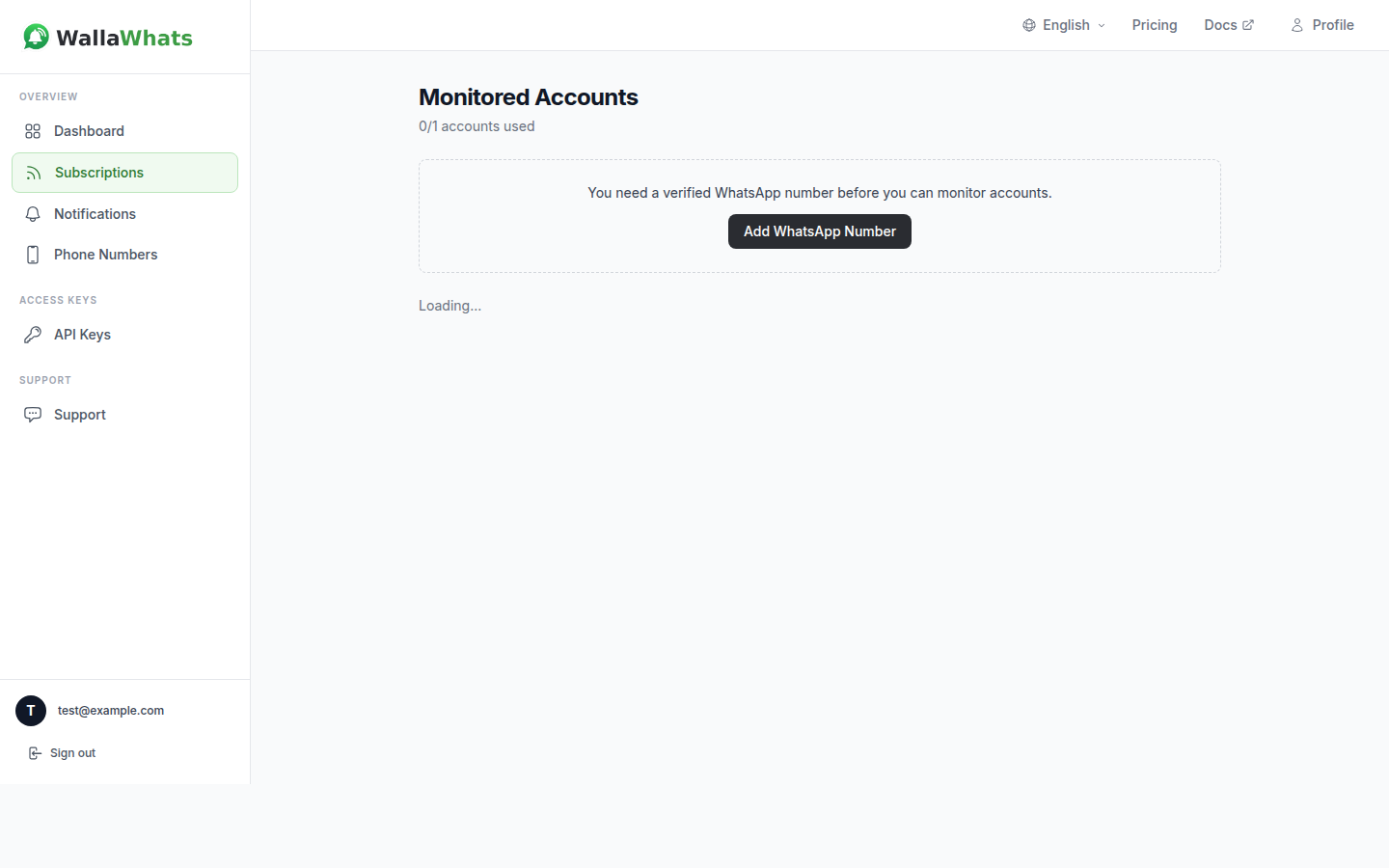
1. Sign up and verify a destination. Sign-in is passwordless — a 6-digit code sent to WhatsApp or email gets you in without a password to manage. Verify your WhatsApp number (and optionally an email as backup) on the Channels page; every alert fans out to all your enabled, verified channels, so a hiring signal reaches you the same way whether you’re at your desk or between calls.
2. Add target companies and key people to Subscriptions. Head to Subscriptions and add the X handle for each company, hiring manager, and industry voice on your list. The Free plan covers 2 accounts — enough to prove the model on one priority requisition — and paid tiers scale up from there as your desk grows.
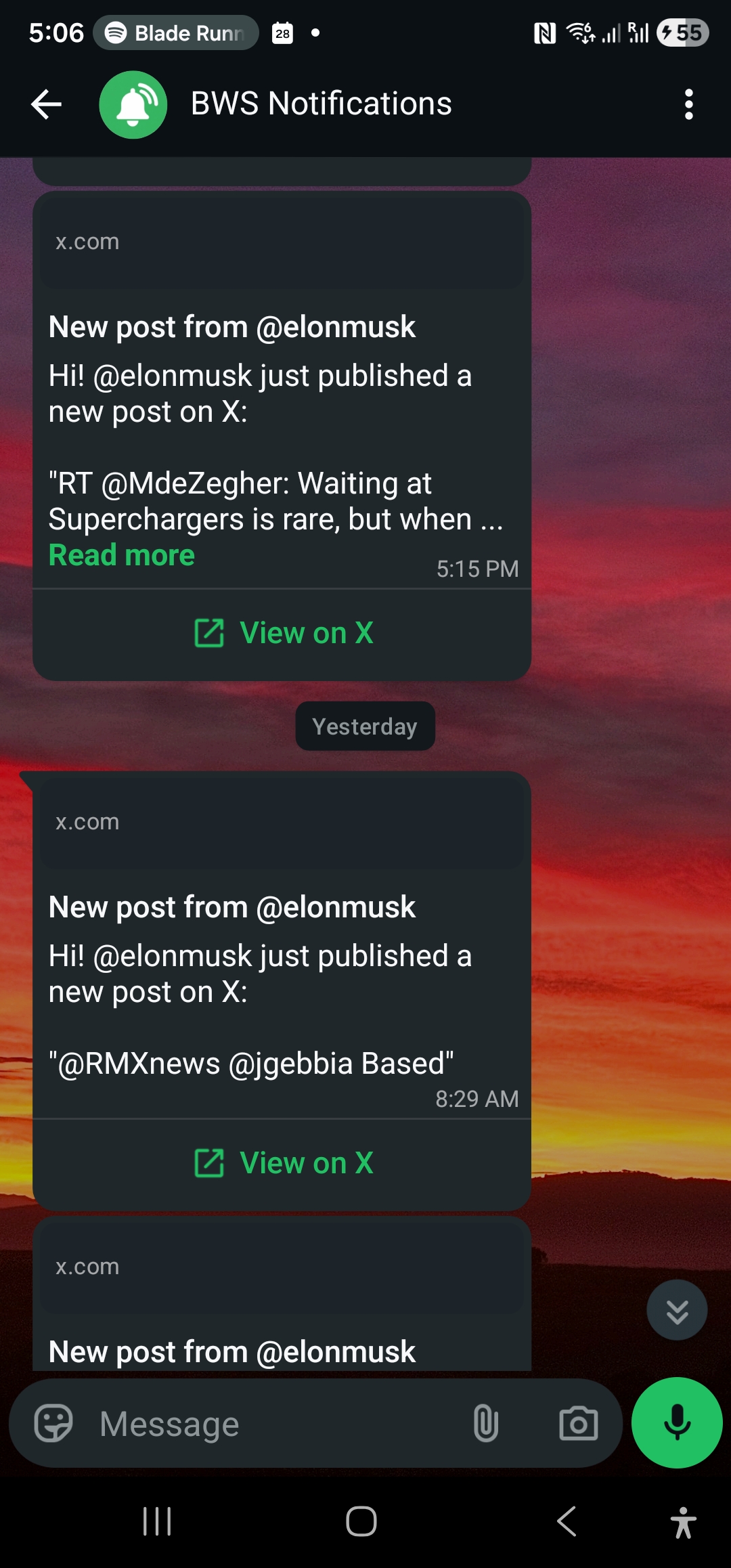
3. Let alerts do the watching. From that point on, a new post from any monitored account triggers a WhatsApp message within seconds of going live, with the handle and a link back to the original on X. Turn on email as well and the full post text arrives there, so you can act on the real thing rather than a summary.
For recruiting teams managing subscriptions programmatically — syncing a watchlist from an ATS, or auto-adding a company’s handle the moment a new requisition opens — the same subscription management is available over the WALLAWHATS REST API, authenticated with a simple x-api-key header:
curl -X POST https://api.wallawhats.com/subscriptions \
  -H "x-api-key: your_api_key_here" \
  -H "Content-Type: application/json" \
  -d '{"xUsername": "target_company_handle"}'
Handling Announcement Days Without Getting Buried
Funding announcements, all-hands reorgs, and layoff days tend to produce a burst of related posts from the same handful of accounts in a short window — a company account, several executives, and a wave of employees all posting within the hour. Without protection, that’s a string of WhatsApp pings in quick succession, which is exactly the kind of noise that gets a channel muted, defeating the point of watching for these moments at all.
WALLAWHATS applies a per-user velocity cap on a rolling 60-minute window. Once your alert volume crosses your plan’s hourly threshold, additional posts get buffered into a digest and delivered as one consolidated message per account every 15 minutes instead of arriving individually. You still see every post — just batched instead of scattered during the busiest hours, which tend to be exactly when a layoff or funding story breaks.
| Plan | Monthly alerts | X accounts | Velocity cap (alerts/hr) |
|---|---|---|---|
| Free | 3 | 2 | 2 |
| Pro | 50 | 3 | 5 |
| Pro+ | 250 | 10 | 15 |
| Business | 1,000 | 20 | 30 |
| Enterprise | 3,000 | 50 | 100 |
An independent recruiter tracking a handful of priority accounts fits comfortably on Free or Pro. An in-house talent acquisition team watching a broader set of target companies, competitor teams, and industry voices — with room for an announcement-day burst — benefits from Pro+ or Business, both for the larger account cap and the higher velocity threshold. For the full mechanics of how the digest batching works, see Avoiding Alert Storms.
Acting on a Hiring Signal Fast
Catching the signal only pays off if the outreach that follows is quick and specific. A few habits make the difference:
- Reference the actual post. Because every alert links back to the original on X, outreach can point to the specific announcement — “saw your team just posted about the new platform launch” reads very differently from a generic cold open.
- Route the signal to the right desk immediately. A layoff post at a target company might be a sourcing signal for one recruiter and a client-development signal for another; the alert should reach whoever owns that account or relationship the same hour it lands, not after a daily digest.
- Move within the day, not the week. A public hiring or layoff post gets noticed by a lot of recruiters at once. The advantage isn’t in seeing it — every competitor with a similar watchlist sees it too — it’s in being one of the first to reach out with something specific before the candidate’s or hiring manager’s inbox fills up.
Notification History as a Recruiting Audit Trail
Every alert WALLAWHATS delivers is logged as a row in your notification history — one entry per channel per post, with a status trail of queued, sent, delivered, and, for WhatsApp when the recipient has read receipts enabled, read. For a recruiting desk, that history doubles as a timestamped record of exactly when a public signal became available, which is useful the next time someone asks how early a role or a layoff was spotted, or wants to confirm outreach followed the announcement rather than the other way around. Pull it from the dashboard or the GET /notifications API endpoint, filtered by date range — see Every Alert Tracked for a full walkthrough of what each status means.
The same underlying mechanics power a related use case worth knowing about if your desk also does sales or business development: Trigger-Event Selling covers how sales teams use the identical watch-and-alert pattern to act on funding rounds and executive hires the moment they go public.
What This Doesn’t Do
Worth being direct about the limits: this surfaces what companies and individuals choose to post publicly on X — it doesn’t infer anything about someone who hasn’t posted, and it isn’t a way to build a profile of a specific private person. It’s a real-time layer on top of public, self-disclosed signal, not a replacement for the relationship-building, referrals, and direct conversations that still do most of the work in recruiting. What it reliably does is close the gap between “this became public” and “my desk knew about it” — and in a business where minutes decide who gets the first conversation, that gap is usually the whole game.
Start Watching Your Priority List
You don’t need a full recruiting stack to try this. Add your top few target companies and industry accounts on the Free tier — 2 monitored accounts and 1 verified WhatsApp number, no credit card required — and see what it feels like to have a hiring signal land on your phone within seconds instead of finding it secondhand. Every subscription is opt-in, every destination is verified with its own one-time code, and every alert links straight back to the original post on X.
Never miss an important post again. Create a free account — 1 WhatsApp number, real-time alerts, no credit card required.
About the author
Nacho Coll
Founder & Engineer at WallaWhats
Nacho founded WallaWhats so you get the alerts that matter without depending on X's algorithm to surface them — pick the accounts you care about and get a WhatsApp for every post the moment it goes live, in order, nothing throttled or buried. Writes about real-time notification systems, social-signal monitoring, and serverless delivery pipelines from the operator side of the wire.