Track Crypto Accounts on X: Real-Time Alerts for Traders
Follow crypto analysts, exchange accounts, and protocol teams on X with instant WhatsApp alerts. Never miss a listing, hack notice, or governance vote.
 by Nacho Coll
Nacho founded WallaWhats so you get the alerts that matter without depending on X's algorithm to surface them — pick the accounts you care about and get a WhatsApp for every post the moment it goes live, in order, nothing throttled or buried.
Crypto markets react to a handful of X posts every single day. An exchange lists a new token, a protocol team announces a governance vote, or an analyst drops a thread at 2 AM — and by the time you open your phone and scroll to the tweet, the price has already moved.
The problem isn’t that you’re not paying attention. The problem is that the X feed algorithm decides what you see and when. Subscribe to fifty accounts and you’ll reliably miss the one tweet that mattered most. Mute notifications from the app and you stop the noise, but you also stop the signal.
WALLAWHATS takes a different approach: you pick the X accounts you care about, verify your WhatsApp number once, and receive a WhatsApp message within seconds of each new public post — no algorithm, no infinite scroll, no missed signals. This guide walks through which accounts are worth tracking, how to get set up in under two minutes, and how to handle the velocity quirks that come with high-volume crypto feeds.
Why crypto traders live on X
X (Twitter) remains the primary real-time distribution channel for high-impact crypto information. No other platform combines the reach, the directness, and the speed of a 280-character post from an exchange or protocol team. Here’s where the signal actually comes from:
Exchange listing announcements. Binance, Coinbase, Kraken, OKX, and their peers announce new token listings on X before anywhere else. The price reaction on spot markets often begins within the first thirty seconds of the tweet going live — sometimes sooner. By the time the news hits a crypto media outlet, the pump is either already over or the dump has started. First-mover advantage here is measured in seconds, not minutes.
Protocol governance. DAOs publish governance proposals, parameter change notices, and voting deadlines on X. If you hold tokens in a protocol, missing a governance post can cost you your vote or, worse, expose you to a collateral ratio change or fee switch you didn’t see coming. Governance windows often have tight deadlines — some run for as few as 48 hours.
Security incidents. Hacks, bridge exploits, and smart-contract pauses get reported by protocol teams on X first — usually before Rekt News, before Discord, and well before any official postmortem. An early alert can be the difference between moving funds to safety and watching them drain. In the case of a multisig pause or an emergency guardian action, minutes matter enormously.
Analyst threads. Independent on-chain analysts, quantitative traders, and macro researchers publish market theses, position disclosures, and data breakdowns on X. These threads move retail sentiment — sometimes dramatically. Knowing when a widely followed analyst has published a new long or short thesis before the crowd piles in is a genuine edge.
Macro and regulatory announcements. Regulators, central bank officials, treasury secretaries, and committee chairs with jurisdiction over digital assets are on X. A thread on stablecoin legislation or a surprise rate comment from a Fed official can hit before any newswire picks it up, and the crypto correlation to macro events has only grown in recent years.
The common thread across all of these: they are time-sensitive, they originate from public X accounts, and your edge is receiving them within seconds — not minutes.
Accounts worth tracking by category
Not all crypto accounts are equal. Here’s a practical breakdown of the categories that consistently generate actionable information, and the reasoning behind each.
Exchange official accounts
Every major centralized exchange has a primary X account used for listing announcements, maintenance windows, delistings, and promotional events. These accounts tend to be relatively sparse — they don’t post every hour — but when they do post, it matters. A new listing announcement is the canonical example: the tweet goes out, spot volume spikes, and the window for entry/exit at pre-announcement prices closes fast.
Exchange accounts also post ahead of maintenance or trading suspension events, which is important if you run automated strategies or have open limit orders.
Protocol and project accounts
Every serious blockchain protocol — Layer-1 networks, DeFi platforms, NFT ecosystems, stablecoin issuers — maintains an official X account. Post categories include: mainnet launch announcements, token migration notices, emergency pause declarations, governance votes, airdrop windows, and partnership announcements. If you hold or farm a protocol’s token, subscribing to the official account is table stakes.
Core developer accounts
Protocol developers often share information on their personal accounts before the official project account publishes anything. This includes early comments on audit reports, previews of upcoming changes, and candid assessments of vulnerability disclosures — sometimes with hours of lead time over the official announcement. If you follow a protocol closely, finding the Twitter handle of the lead developer or founder is worth the effort.
Independent on-chain analysts
A small group of independent researchers publishes high-quality on-chain analysis and trade theses on X. These accounts are harder to find through the algorithm because they’re not amplified by exchange advertising budgets, but their signal-to-noise ratio is typically much higher than mainstream crypto media. Their posts drive retail action, so being an early reader matters.
Regulatory and macro accounts
Central bank communication accounts, finance ministry handles, and individual officials with crypto jurisdiction round out a serious watch list. Regulatory announcements on stablecoin frameworks, exchange licensing decisions, or AML guidance can move the entire market. The accounts posting this content are public, their posts are public, and the lead time over structured newswires is real.
Setting up WhatsApp alerts in under two minutes
WALLAWHATS is a third-party service that uses the public X API to monitor posts from accounts you choose. Here’s how to get started:
Step 1 — Create a free account
Go to https://wallawhats.com/signup. Enter your email and you’ll receive a 6-digit one-time code. Enter it and your account is created — no password to set or remember.
Step 2 — Verify your WhatsApp number
On the Channels page, add your WhatsApp number in international format (for example, +14155552671). WALLAWHATS sends a 6-digit verification code to that number via WhatsApp. Enter it in the dashboard and your delivery destination is verified. From this point on, every alert from every subscription you create fans out to this number.
You can also add an email address as a second channel — same verification flow, separate one-time code. When both are enabled, every alert goes to both destinations simultaneously. Email alerts include a rendered PNG snapshot of the tweet inline, plus access to the dashboard’s 30-day searchable snapshot gallery.
Step 3 — Subscribe to X accounts
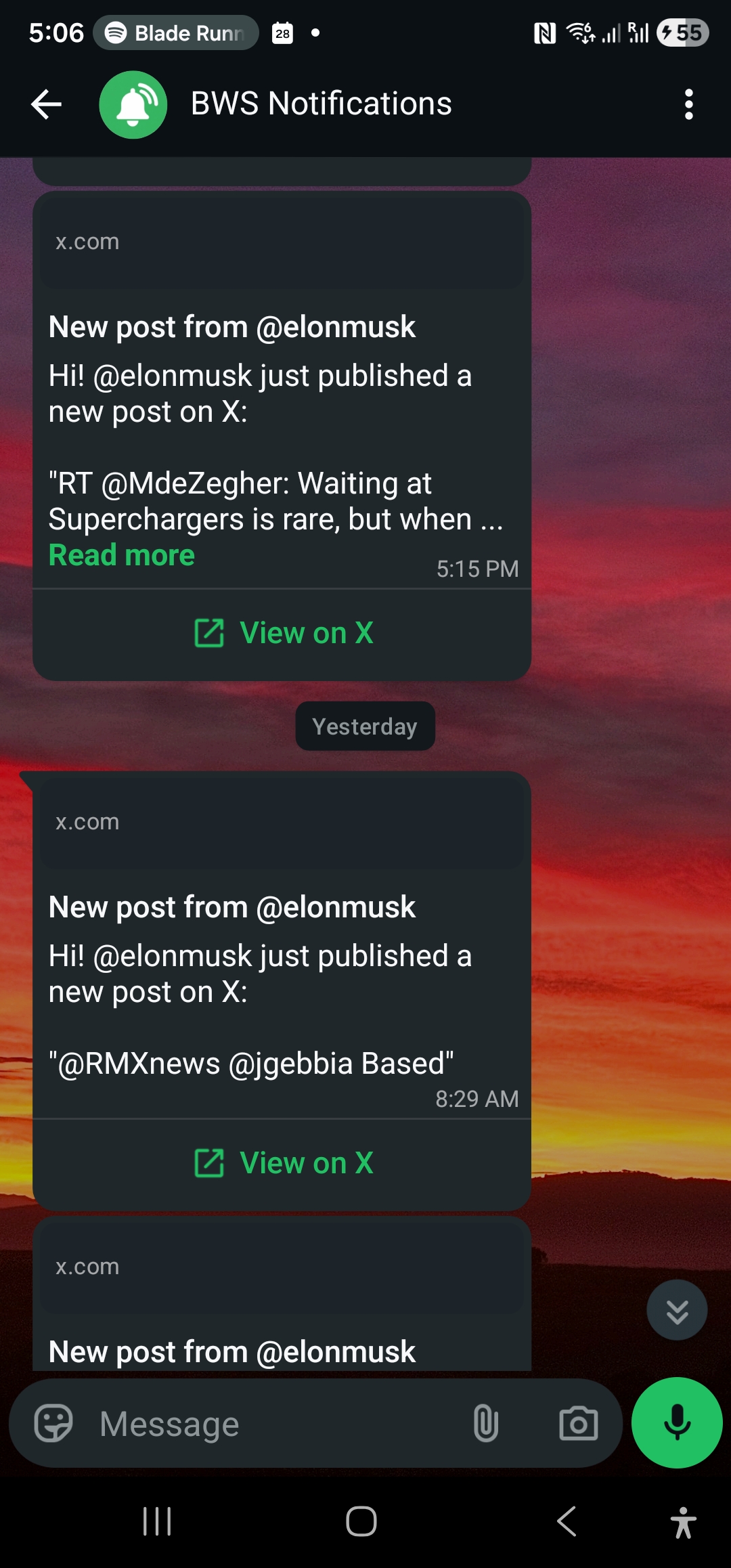
On the Subscriptions page, enter the X handle you want to monitor (no @ — just the username). Click Subscribe. Done. Within seconds of the account’s next public post, a WhatsApp message arrives with a View on X link straight back to the original tweet. Add an email channel and the full post text lands in your inbox alongside it.
The Free plan supports 2 subscribed accounts. Pro supports 3, Pro+ supports 10, Business supports 20, and Enterprise supports 50. You can upgrade at any point from the dashboard.
Handling velocity: the alert storm problem
Exchange accounts and major protocol accounts can post dozens of times during an active market event — a listing announcement gets followed by trading-start confirmation, fee schedule updates, regional announcements, and social engagement from the exchange’s marketing team. Left uncapped, a busy hour could generate thirty WhatsApp messages from a single account.
WALLAWHATS handles this with per-plan velocity caps and automatic digest batching:
| Plan | Alerts per hour (rolling window) |
|---|---|
| Free | 2 |
| Pro | 5 |
| Pro+ | 15 |
| Business | 30 |
| Enterprise | 100 |
These caps apply across all your subscriptions combined on a rolling 60-minute window. When the cap is hit, additional tweets are buffered — not dropped — and flushed every 15 minutes as a digest message grouped by X handle. You still see every post; you get them in batches during bursts rather than one message per tweet.
For most crypto watch-list scenarios this works well:
- Normal hours. A listing announcement hits, you get the alert within seconds. Same for governance votes and security disclosures. Most exchanges post infrequently enough that individual delivery is the norm.
- Event bursts. During a product launch, a market stress event, or a Twitter Spaces promotion when an account posts repeatedly in a short window, you receive a digest bundling the burst, then return to individual delivery once activity normalises.
If you want to stay below the cap threshold for all but the most extreme scenarios, the Pro+ plan (15 alerts/hour) handles most realistic watch-list sizes comfortably. For a Business-tier account monitoring 20 accounts — including several high-volume exchange handles — the 30 alerts/hour cap provides meaningful headroom. The velocity caps and digest batching article covers the mechanics and the digest message format in detail.
Why WhatsApp delivers better than push notifications or email
When you’re monitoring a listing that triggers a price reaction in the first thirty seconds, delivery speed and notification behaviour both matter.
Speed. WhatsApp messages are dispatched within seconds of a post becoming publicly visible on X. Email averages 1–5 minutes of latency due to SMTP queuing and inbox filtering. Push notifications from the X app itself are subject to the feed algorithm — you’ll often receive them for accounts you don’t follow but whose posts performed well, while missing posts from the accounts you do follow.
Notification behaviour. WhatsApp messages reliably bypass most “Do Not Disturb” configurations that would silence email client notifications. If you’re monitoring a protocol you have a significant position in, you likely want the alert to reach you even when your phone is silenced for the night.
Inbox hygiene. Email alert fatigue is real. Multiple subscriptions generating daily email volume competes for attention with everything else in your inbox. WhatsApp messages arrive in a dedicated app, clearly separated from work and personal communication.
That said, email is genuinely useful for archiving and audit. On every WALLAWHATS plan you can enable both channels, and many traders use exactly this setup: WhatsApp for real-time reaction, email for the searchable record. The email vs WhatsApp comparison covers latency data and read-rate differences in detail if you want to dig into the trade-offs.
Programmatic subscriptions via the REST API
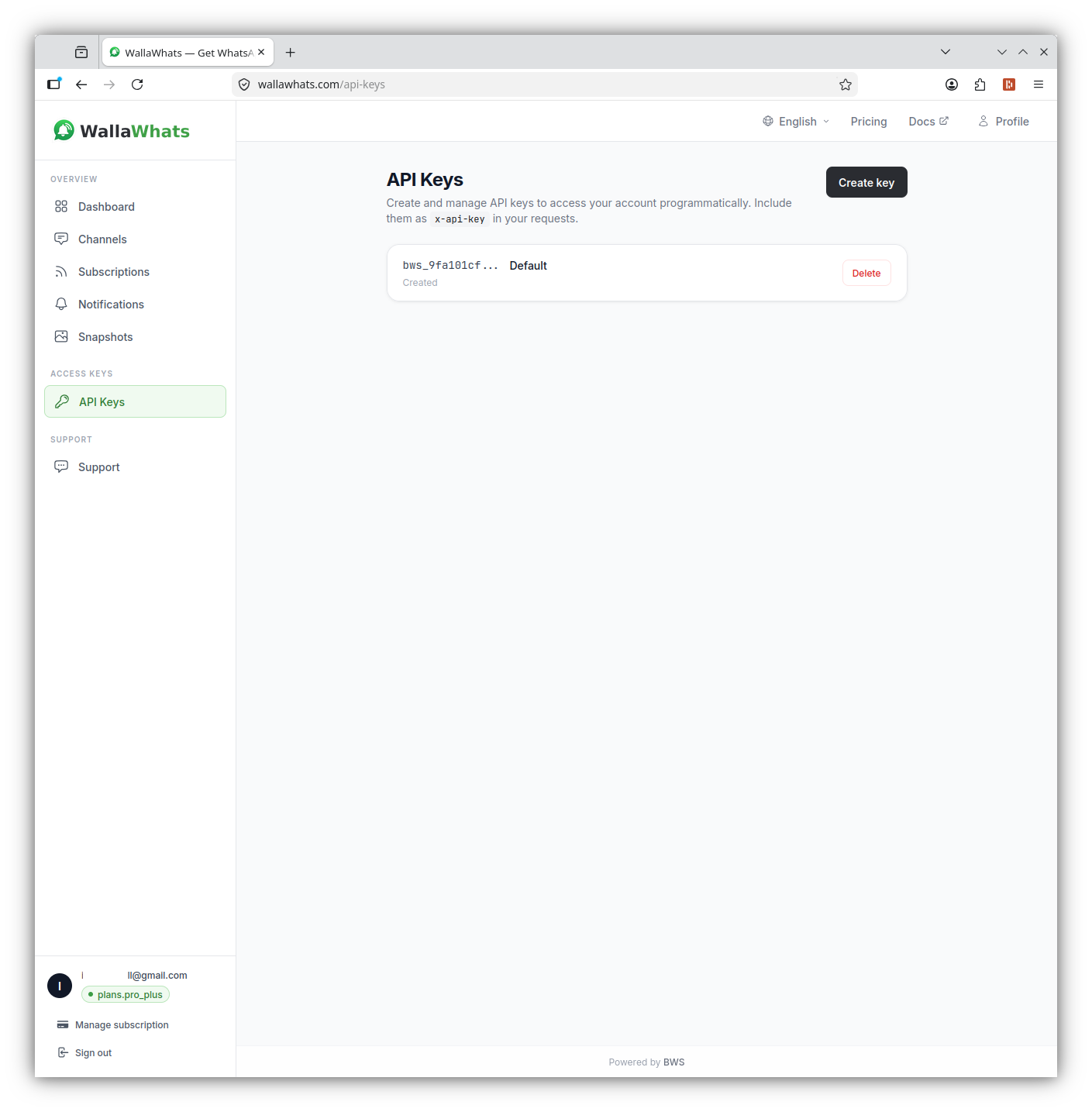
If you want to wire WALLAWHATS into your own tooling — a trading dashboard, a portfolio tracker, a bot that mirrors alerts into a team Slack — every plan includes at least one API key. API access is not an enterprise-only feature.
The REST API is at https://api.wallawhats.com. Authenticate with the x-api-key header.
Add a subscription
curl -X POST https://api.wallawhats.com/subscriptions \
  -H "x-api-key: <your-key>" \
  -H "Content-Type: application/json" \
  -d '{"xUsername": "Binance"}'
List all active subscriptions
curl https://api.wallawhats.com/subscriptions \
  -H "x-api-key: <your-key>"
Pull notification history
curl "https://api.wallawhats.com/notifications?from=1750000000000&to=1751000000000" \
  -H "x-api-key: <your-key>"
The response is paginated using a lastKey cursor. Each row includes the X handle, the post text, the timestamp, the delivery channel, and the delivery status (queued, sent, delivered, read, or failed). You can use this endpoint to build a latency monitor per account, or to replay alerts missed during a connectivity gap.
Full documentation is at https://wallawhats.com/docs/api-reference. The X alerts API guide has worked examples in curl, Node.js, and Python.
What WALLAWHATS monitors — and what it doesn’t
WALLAWHATS uses the public X filtered-stream API. A few important constraints:
- Only public accounts are eligible. Protected accounts and follower-only content are refused at subscription creation — we cannot and do not monitor private posts.
- Delivery is near real-time, typically within seconds of a post becoming publicly visible on X. Brief API fluctuations or posts that are deleted before delivery can occasionally cause gaps. We do not promise delivery of every post from every account under all conditions.
- Tweet content is delivered verbatim — no paraphrasing, no summarisation, no AI rewriting. The post text in your email alert is exactly what the account published; WhatsApp alerts link straight to the original.
- Tweet snapshots (rendered PNG images) are retained for 30 days in your dashboard gallery, then automatically purged per X developer policy requirements.
WALLAWHATS is a third-party developer application using the public X API. It is not affiliated with, endorsed by, or sponsored by X Corp.
Suggested watch-list configurations
Here are practical starting points based on plan tier:
Business plan (20 accounts, 30 alerts/hour)
Allocate roughly 5 slots to the major exchange official accounts you actively trade on, 5 to Layer-1 and DeFi protocol accounts where you hold meaningful positions, 5 to independent on-chain analysts whose signal you follow closely, and 5 to macro or regulatory accounts. This covers the main categories while staying below the velocity cap on all but the most active days.
Pro+ plan (10 accounts, 15 alerts/hour)
Tighten the list to the 3–4 exchanges you actually use for spot or derivatives trading, 3–4 protocol accounts you’re actively farming or holding, and 2–3 analyst accounts with consistently high signal-to-noise ratios. Governance vote announcements and listing tweets from this shorter list will arrive individually in nearly all circumstances.
Pro plan (3 accounts, 5 alerts/hour)
Pick your single most-used exchange, one high-priority protocol, and one analyst. The velocity cap is tight at this tier, so expect digest batching during any significant event — but the first alert from each burst still arrives within seconds, before the cap triggers.
Free plan (2 accounts, 2 alerts/hour)
One high-signal source — for example, the official account of the exchange you rely on most — and one analyst or project account you monitor most closely. At this cap level, an exchange that posts aggressively during a launch event will trigger digest batching early; the individual listing announcement itself will still arrive in real-time before the cap hits.
You can add, remove, and swap subscriptions at any time with no penalty.
Never miss an important post again. Create a free account — 1 WhatsApp number, real-time alerts, no credit card required.
About the author
Nacho Coll
Founder & Engineer at WallaWhats
Nacho founded WallaWhats so you get the alerts that matter without depending on X's algorithm to surface them — pick the accounts you care about and get a WhatsApp for every post the moment it goes live, in order, nothing throttled or buried. Writes about real-time notification systems, social-signal monitoring, and serverless delivery pipelines from the operator side of the wire.